
TCC Celebrates New Aviation Learning Spaces
Published
Field of Study
Air Traffic ControlTulsa Community College celebrated expanded Aviation learning spaces and the completion of a second Air Traffic Control simulator at its Riverside Community Campus and Aviation Center. The updates support growing Aviation enrollment and give students more access to simulation-based training as they prepare for high-demand careers.
Tulsa Community College showcased new Aviation learning spaces at its Riverside Community Campus and Aviation Center during an open house celebrating expanded classroom space and the completion of a second Air Traffic Control simulator.
The updates come as TCC’s Aviation programs continue to grow. Enrollment increased from 300 students last fall to 339 students this fall, a 13% increase. The Air Traffic Control program has seen even stronger growth since TCC joined the FAA’s Enhanced Air Traffic–Collegiate Training Initiative, growing from 21 students in its first year as an Enhanced program to 42 students this fall.
“The new simulator gives students additional access to technology used in simulated air traffic control scenarios. It supports the same core training functions as TCC’s original Air Traffic Control simulator while giving the program more capacity as enrollment grows,” says TCC Dean of Science & Aeronautics Julie Porterfield. “The expanded classroom space gives us more flexibility to serve a growing number of students while maintaining the focused learning environment our programs require.”
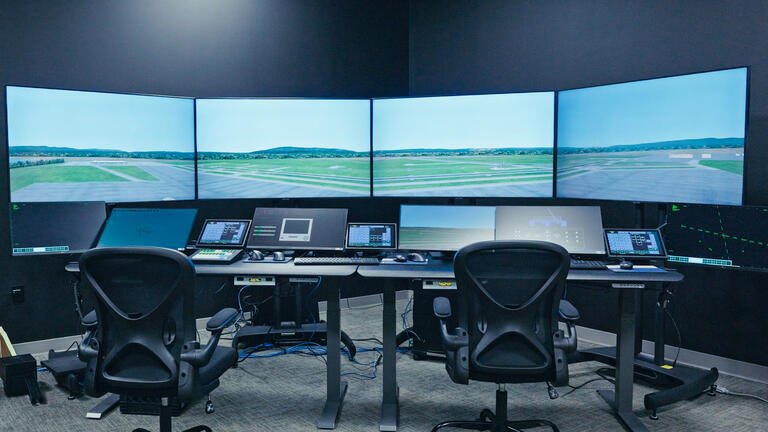
The Aviation Center already includes a fleet of technically advanced aircraft, its original $1.4 million Air Traffic Control simulator, and a flight simulation lab with a full-motion flight training simulator. TCC also offers dual credit enrollment and university transfer general education classes at the campus.
New learning spaces, including the second simulator, were supported by the Critical STEM grant. The Hardesty Family Foundation helped fund the demolition of the former tower simulator room to make way for the new classroom space, as well as two flight data computer systems for the simulator rooms.
For Air Traffic Control students, simulation-based learning is a major part of preparing for the field. Students use the simulators to practice communication, timing, and problem-solving in scenarios before entering aviation careers.
Jasmine Truong, an Air Traffic Control student originally from California, said learning on the Aviation Center’s first simulator helped confirm she had found the right career path after previously studying aerospace engineering.
“After finishing my first simulator class, I was certain I had found my career path,” Truong said. “Having the second simulator will allow us to have more simulator time to give students more opportunities to build confidence and prepare for careers in aviation.”
Tate Frieders, an Air Traffic Control student from Illinois, came to TCC after researching programs across the country. He said TCC stood out because he could earn his degree in two years at a more affordable cost while studying in an Enhanced AT-CTI program.
“The first time I walked into the space, I was amazed,” Frieders said of TCC’s original Air Traffic Control simulator. “It gives students a chance to practice managing aircraft in simulated scenarios and connect what we learn in class to what controllers actually do.”
Related News
TCC Announces $57 Million Renovation to Metro Campus
Tulsa Community College has announced plans for a major transformation of its Metro Campus, with a $57 million renovation that will modernize learning spaces, improve student and faculty areas, and better connect the downtown campus.
Tulsa Community College Sees Highest Enrollment in 13 Years
Tulsa Community College has reached its highest fall enrollment since 2013, with more than 17,000 students enrolled for Fall 2026. The milestone marks TCC’s fourth consecutive year of enrollment growth.
TCC President Named to Oklahoma Higher Education Hall of Fame
Tulsa Community College President and CEO Leigh B. Goodson will be inducted into the Oklahoma Higher Education Hall of Fame's 2026 class. The statewide honor recognizes Goodson’s leadership at TCC and her broader contributions to higher education, student success, and educational opportunity in Oklahoma.