
Respiratory Care, A.A.S.
Looking for a top respiratory therapist school? TCC’s Respiratory Care A.A.S. trains students with hands-on experience for high-demand healthcare careers.
About the Respiratory Care Degree
- This program centers on patient care, particularly in emergency situations. You will learn to provide compassionate care at its core.
- The Respiratory Care Program's goal is to prepare graduates who excel in knowledge, skills, and behavior within the field. These graduates can become registered respiratory therapists (RRTs).
- If you thrive in a fast-paced environment that demands both technical and interpersonal skills, this program is tailored for you.
- Respiratory Care is a specialized healthcare field that encompasses preventing, diagnosing, treating, managing, and rehabilitating patients with lung disorders.
- As an advanced respiratory therapist, you will be involved in life-saving situations, collaborating with doctors, nurses, and other healthcare professionals. Your expertise will be in high demand.
- The program prepares students for the National Board for Respiratory Care (NBRC) Certification and Registry Examinations, a crucial step in earning a respiratory therapist degree and gaining licensure to practice respiratory care.
Respiratory Care Degree Details
Discover the Respiratory Care A.A.S. program. Life-saving skills in two years.
Why choose TCC for respiratory therapy? According to the U.S. Bureau of Labor Statistics, employment of respiratory therapists is projected to grow 12 percent from 2024 to 2034, much faster than the average for all occupations. Respiratory therapists earned a median annual wage of $80,450 in 2024. An aging population and increased need for respiratory care services are driving demand for qualified professionals in hospitals, clinics, rehabilitation facilities, and physician offices.
The Respiratory Care Program is a full-time, daytime program that can be completed in two years (five consecutive terms). The curriculum is carefully designed with specialized Respiratory Care courses that must be taken in a specific sequence to ensure student success and competency development.
Classes for Respiratory Care courses are offered in person at the Tulsa Metro Campus. To help reduce their workload during the program, students are encouraged to complete general education courses before entering the program. Human Anatomy and Physiology is a required prerequisite and must be completed prior to acceptance.
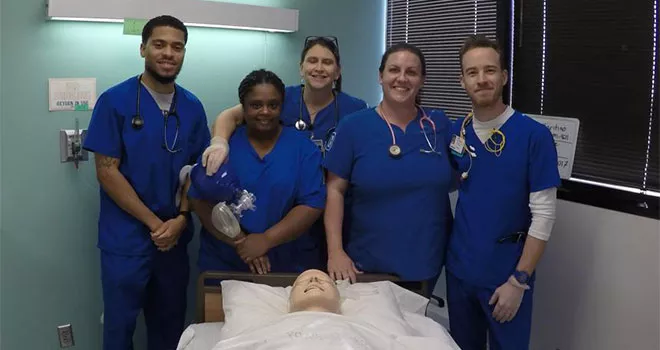
As a Respiratory Care student, you will study a wide range of topics related to respiratory health, disease management, and advanced respiratory care techniques. Learning experiences include classroom instruction, hands-on laboratory practice, and supervised clinical rotations in hospitals, where you will work directly with patients and healthcare professionals.
Upon graduation, you will be prepared to enter the profession as a respiratory therapist and demonstrate the knowledge, critical-thinking abilities, technical skills, and professional behaviors expected of a Registered Respiratory Therapist (RRT)
Graduates of the Respiratory Care Program are awarded an Associate Degree in Applied Science and eligible to apply for the National Board for Respiratory Care (NBRC) Examinations. The Respiratory Care profession is licensed in virtually every state, and graduates are prepared to pursue the NBRC credentials and state licensure required for professional practice.
After successfully completing this program, you will have the ability to:
- Apply respiratory care knowledge, critical thinking, and problem-solving skills to deliver effective patient care in a variety of healthcare settings.
- Assess patients and recommend appropriate diagnostic procedures to support clinical decision-making.
- Communicate professionally and effectively with patients, families, and members of the healthcare team.
- Demonstrate compassion, cultural awareness, and respect for the diverse needs of patients and communities.
- Adhere to professional standards related to ethics, patient safety, infection prevention, and accurate documentation.
- Utilize evidence-based practice to develop and implement individualized patient care plans.
- Operate, monitor, and troubleshoot respiratory care equipment used across a wide range of patient care environments.
View the Degree Requirements to find out which courses and credits you'll need to earn your degree.
Explore the Program Map to see how you can complete your degree.
The TCC Respiratory Care (RESP) Program admits a new cohort of students each year, with classes beginning in August at the Metro Campus.
Admission to the program is highly competitive. Meeting with a Health Sciences Academic Advisor and attending the Smart Start Orientation are essential steps in the application process.
Follow these steps to apply:
- Apply for Admission to TCC — If you have not been enrolled at TCC within the past year, you must complete a new admission application
- Submit your high school and any college transcripts
Please note: Admission to TCC does not guarantee admission to the DMS Program.
- Submit your high school and any college transcripts
- Contact a Health Sciences Academic Advisor
- Attend the Allied Health Smart Start Orientation
- Review the School of Health Sciences Policies & Procedures
- Review the Respiratory Care Essential Functions
- Review the Estimated Cost of the Respiratory Care Program.
- Review the Respiratory Care Application Scoring Rubric
- Complete TCC Accuplacer Math and Reading exams
- Apply to the Respiratory Care Program: Applications are open annually from September 1 to April 15.
- Check your TCC email for correspondence about your application. All application correspondence from the School of Health Sciences will be through your TCC email only.
We're here to help you succeed. Contact us at healthsciences@tulsacc.edu for more information.
Admission Requirements
To be eligible for admission to the RESP Program, applicants must:
- Maintain a minimum college GPA of 2.5
- Complete the TCC Accuplacer Math and Reading exams within the last 5 years of the current application deadline
- Minimum recommended score for Math of 237
- Minimum recommended score for Reading of 263
- Complete prerequisite courses with a grade of "C" or better.
These courses must be completed by the end of the spring semester in which the student is applying:- BIOL 1314 - Essentials of Anatomy and Physiology
- BIOL 1314 - Essentials of Anatomy and Physiology
Interview & Admission Notification
- Eligible applicants are ranked using the established scoring rubric.
- Admission decisions are based on each applicant's academic qualifications.
- Applicants will be notified of their admission status through their TCC email account.
Clinical Requirements
Students admitted to the program must:
- Be able to travel to local and distant clinical sites.
- Complete an extensive criminal background check, which includes, but is not limited to, a seven-year county of residence nationwide criminal history check, national sexual predator screening, Social Security check, and Medicare/Medicaid fraud screening.
- Complete a 10-panel drug screening, which includes, but is not limited to, testing for oxycodone, cocaine, benzodiazepines, methadone, barbiturates, marijuana, opiates, phencyclidine (PCP), amphetamines, and propoxyphene.
- Submit all required immunization records, certifications, and clinical compliance training documentation.
- Clinical requirements are subject to change. Students are responsible for completing any additional requirements established by clinical affiliates.
See the School of Health Sciences Policies & Procedures for additional information about clinical compliance requirements.
The TCC Respiratory Care program is accredited by the Commission on Accreditation for Respiratory Care (CoARC). Our program number is 200146.
Status: Continuing Accreditation
CoARC
264 Precision Blvd
Telford, TN 37690
817-283-2835
webmaster@coarc.com
Program Goal
The Respiratory Care Program's goal is to prepare graduates who excel in critical thinking, knowledge, skills, and behavior within the field.
After graduation from the program, graduates can become registered respiratory therapists (RRTs) after successfully completing the NBRC national board exam.
Program Outcomes
CoARC accredits respiratory therapy education programs in the United States. To achieve this end, it utilizes an ‘outcomes based’ process. Programmatic outcomes are performance indicators that reflect the extent to which the educational goals of the program are achieved and by which program effectiveness is documented. Learn more about CoARC Programmatic Outcomes Data.
Program Director
Sheila A. Ferris MHA, BSRTT, RRT-NPS
Director of Clinical Education
Jessica Wilson, B.A., RRT-ACCS, RRT-NPS
Respiratory Care Medical Director
Dr. Hassan Abouhouli, MD
Assistant Professor
Evan Butron RRT-ACCS, CPFT
Supporting Faculty
Adam Hammerschmidt & Dana Wade
Program Contact
Contact us to learn more about how to become a respiratory therapist and join one of the top schools for respiratory therapy.
Program Director
Sheila A. Ferris MHA, BSTT, RRT-NPS
918-595-8909
sheila.ferris@tulsacc.edu
School of Health Sciences
TCC Metro Campus
909 S. Boston Ave.
Tulsa, OK 74119
918-595-7002
healthsciences@tulsacc.edu
Careers in Respiratory Care
Graduates of TCC’s program are well-prepared for rewarding careers as respiratory therapists, offering life-saving care in various healthcare settings. Whether you're exploring schools for respiratory therapists or seeking a career in respiratory therapy, TCC provides a clear path to success.
Schedule a session with Career Services to explore resources for job placement and planning.